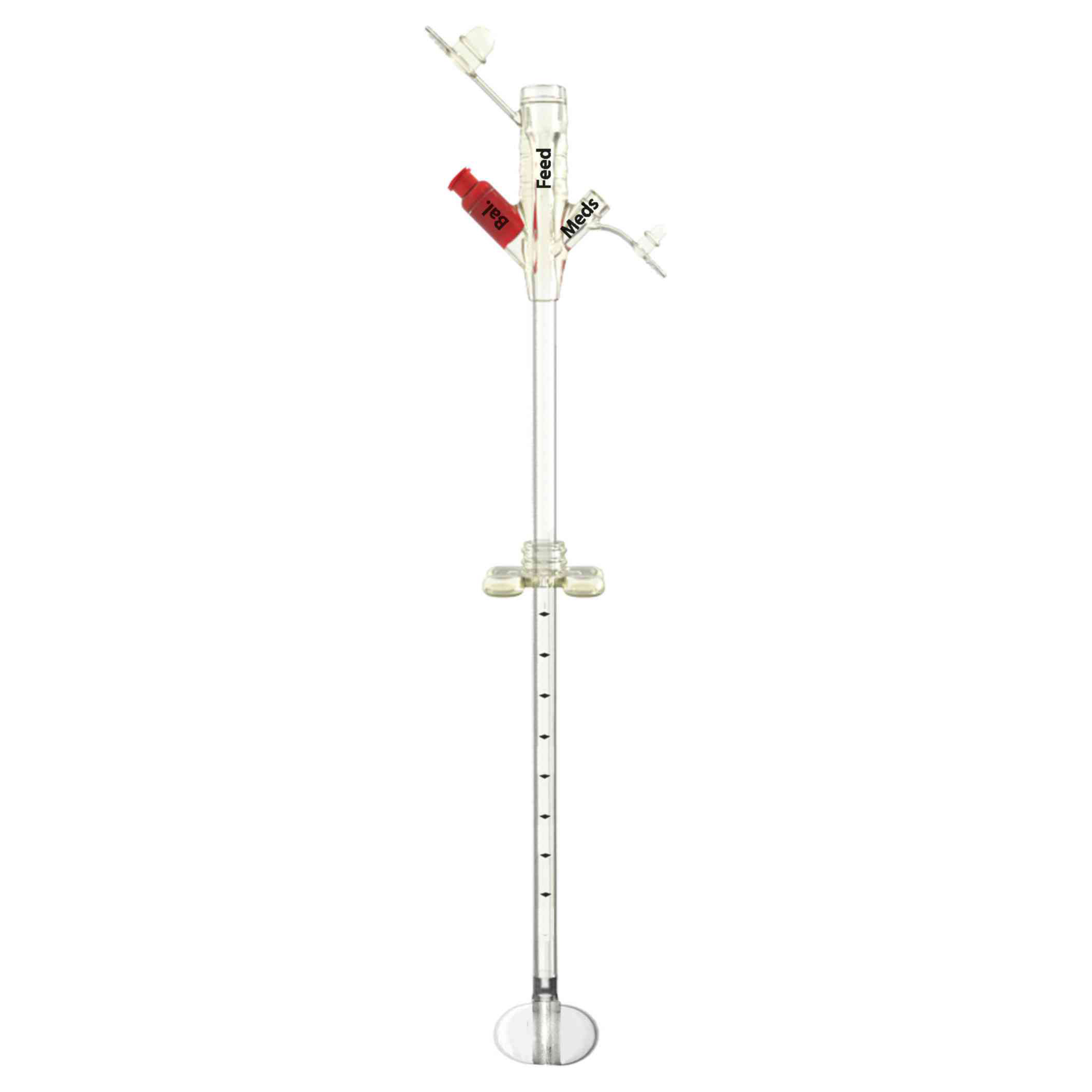
MIC Gastrostomy Feeding Tube is designed for patients who require a bolus feeding method. It is manufactured from medical-grade silicone, offering durability, flexibility, and enhanced visibility during placement. The tube includes an inflatable silicone internal retention balloon to help keep it securely positioned. Its Secur-Lok external retention ring allows airflow around the stoma area and helps reduce pressure evenly around the stoma wall for improved comfort and stability.
Features
- Available in six French size options.
- Dual exit ports for efficient feeding and fluid flow.
- Luer-Lok balloon port for secure balloon inflation.
- Radiopaque stripe for clear visibility under imaging.
- Constructed from high-quality medical-grade silicone.
- FDA-approved and CE-certified for quality and safety.
- Dedicated medication port for easy administration of medications.
- Color-coded balloon port based on French size for quick identification.
- Graduated centimeter markings for accurate measurement and placement.
- Inflatable internal retention balloon made from silicone for secure retention.
- Secur-Lok external retention ring for stable placement and improved airflow.
- Universal feeding port connector for compatibility with standard enteral systems.
- Recessed distal tip when inflated to the recommended fill volume for improved comfort.
Indications for Use
Patients who need long-term feeding, cannot tolerate oral feeding, have a low risk of aspiration, need gastric decompression, or need medicine delivered directly into the stomach can utilize the AVANOS MIC Gastrostomy/Bolus Feeding Tube.
Contraindications
Contraindications for placement of a gastrostomy feeding tube include, but are not limited to, ascites, colonic interposition, portal hypertension, peritonitis, and morbid obesity.
Complications
The following complications may be associated with any low-profile gastrostomy feeding tube:
- Infection
- Skin Breakdown
- Pressure Necrosis
- Intraperitoneal Leakage
- Hypergranulation Tissue
- Stomach or Duodenal Ulcers
Note: Verify package integrity. Do not use if the package is damaged or the sterile barrier compromised.
Placement
The AVANOS MIC Gastrostomy / Bolus feeding tubes may be placed surgically, percutaneously under fluoroscopic or endoscopic guidance, or as a replacement to an existing device using an established stoma tract.
- Caution: A gastropexy must be performed to affix the stomach to the anterior abdominal wall, the feeding tube insertion site identified, and the stoma tract dilated before initial tube insertion to ensure patient safety and comfort.
- Caution: Do not use the retention balloon of the feeding tube as a gastropexy device. The balloon may burst and fail to attach to the stomach of the anterior abdominal wall.
- Warning: The insertion site for infants and children should be high on the greater curvature to prevent occlusion of the pylorus when the balloon is inflated.
Balloon Maintenance
Check the water volume in the balloon once a week.
- Insert a Luer slip syringe into the balloon inflation port and withdraw the fluid while holding the tube in place. Compare the amount of water in the syringe to the amount recommended or the amount initially prescribed and documented in the patient record. If the amount is less than recommended or prescribed, refill the balloon with the water initially removed, then draw up and add the amount needed to bring the balloon volume up to the recommended and prescribed amount of water. Be aware that as you deflate the balloon, there may be some gastric contents that can leak from around the tube. Document the fluid volume, the amount of volume to be replaced (if any), the date, and time.
- Wait 10–20 minutes and repeat the procedure. The balloon is leaking if it has lost fluid, and the tube should be replaced. A deflated or ruptured balloon could cause the tube to dislodge or be displaced. If the balloon is ruptured, it will need to be replaced. Secure the tube into position using tape, then follow facility protocol and/or call the physician for instructions.
- Note: Refill the balloon using sterile or distilled water, not air or saline. Saline can crystallize and clog the balloon valve or lumen, and air may seep out and cause the balloon to collapse. Be sure to use the recommended amount of water, as over-inflation can obstruct the lumen or decrease balloon life, and under-inflation will not secure the tube properly.
Balloon Longevity
Precise balloon life cannot be predicted. Silicone balloons generally last 1–8 months, but the life span of the balloon varies according to several factors. These factors may include medications, volume of water used to inflate the balloon, gastric pH, and tube care.
MRI Safety Information
The MIC Gastrostomy Feeding Tubes are MR Safe
Warning:
Do not reuse, reprocess, or resterilize this medical device. Reuse, reprocessing, or resterilization may:


.png)