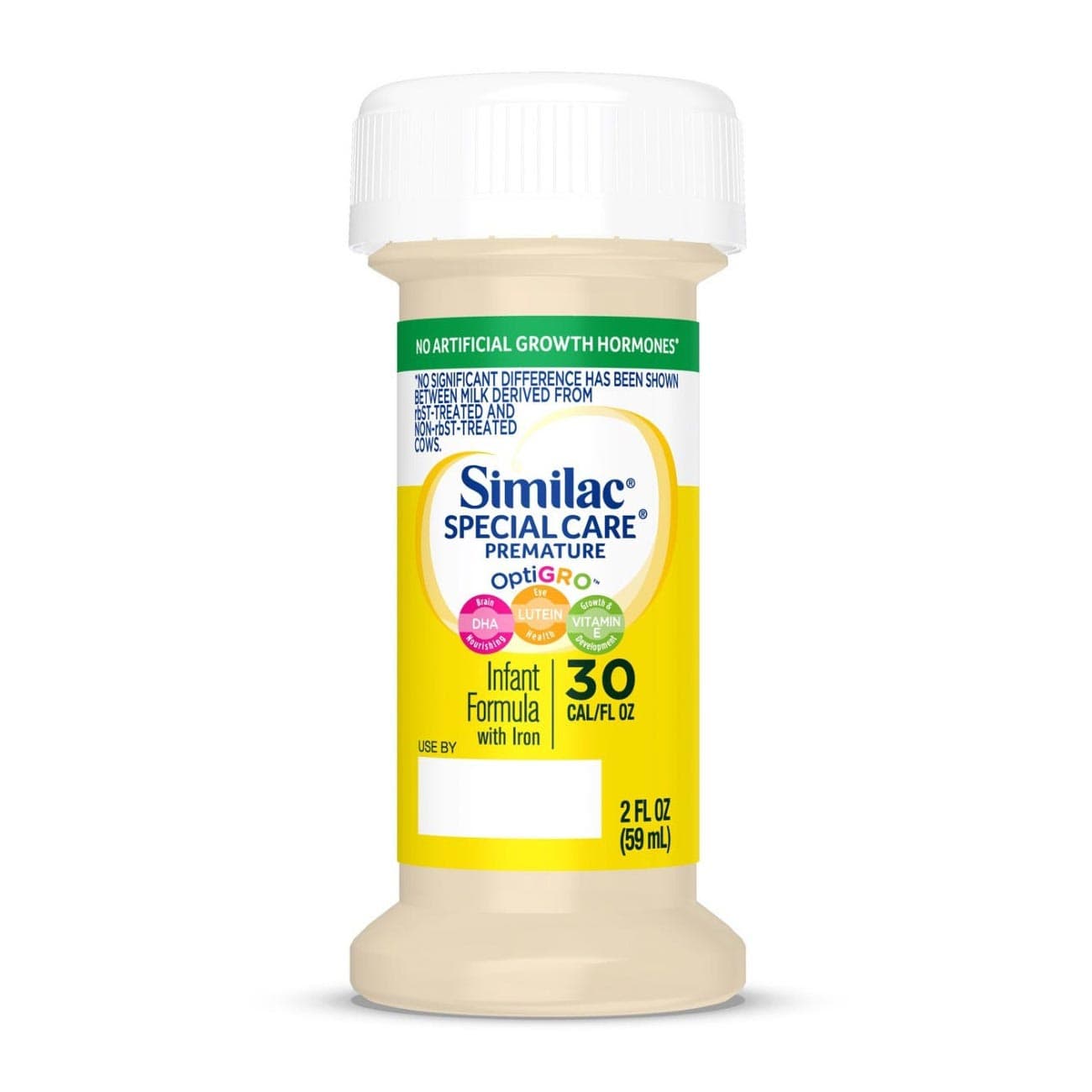
Similac Special Care 30 Premature infant formula with iron
Starts From
Description
Similac Special Care 30 preterm infant formula has 30 calories per fluid ounce and is iron-fortified. It is intended for growing, low-birth-weight, and preterm babies. It can also be administered after discharge, if prescribed by a doctor. First ready-to-feed liquid preterm baby formula with a calorie content of 30 per fluid ounce. Use under medical supervision.
Features
- Halal, Gluten-free.
- Volume: 2 fl oz (59 mL). Bottle
- Suitable as a human milk fortifier.
- Nucleotides help boost the immune system.
- Kosher and manufactured with dairy products.
- It can be blended with human milk to provide a range of calorie densities.
- It can be used as a breast milk extender for women with insufficient milk production.
- Lutein, a carotenoid present naturally in colostrum and human milk, has been demonstrated to promote eye development in preterm infants.
OptiGRO is an exclusive blend of DHA, lutein, and vitamin E: these important ingredients are found in breast milk.
- Lutein to support eye health.
- DHA for brain and eye development.
- Vitamin E to support developing cells.
*Use once feeding tolerance is established.
Ingredients: Water, Nonfat Milk, Corn Syrup Solids, Medium Chain Triglycerides, Soy Oil, Whey Protein Concentrate, Coconut Oil, Lactose. Less than 0.5% of: Schizochytrium Sp. Oil, M. Alpina Oil, Beta-Carotene, Lutein, Calcium Phosphate, Ascorbic Acid, Calcium Carbonate, Soy Lecithin, Monoglycerides, Magnesium Chloride, Sodium Citrate, Inositol, Potassium Hydroxide, Carrageenan, Ferrous Sulfate, Choline Bitartrate, Taurine, Choline Chloride, Niacinamide, L-Carnitine, Zinc Sulfate, d-Alpha-Tocopheryl Acetate, Calcium Pantothenate, Vitamin A Palmitate, Copper Sulfate, Riboflavin, Potassium Citrate, Pyridoxine Hydrochloride, Thiamine Hydrochloride, Folic Acid, Manganese Sulfate, Biotin, Phylloquinone, Sodium Selenate, Vitamin D3, Vitamin B12, Potassium Chloride, Potassium Phosphate, and Nucleotides (Cytidine 5'-Monophosphate, Disodium Guanosine 5'-Monophosphate, Disodium Uridine 5'-Monophosphate, Adenosine 5'-Monophosphate).
- Source of DHA.
- Source of ARA.
Contains milk and soy ingredients.
Instructions for Use:
The health of the infant depends on carefully following the directions for preparation and use. Proper hygiene, handling, and storage are important when preparing infant formula. Wash hands, surfaces, and utensils before preparing feedings. Ask your baby's doctor if you need to boil (sterilize) nipples and rings before use.
- Do not add water.
- Shake very well.
- Do not use if the breakaway ring is missing or broken.
- Twist off cap.
- Twist the nipple and the ring.
- Pour desired amount into feeding container (Volu-Feed or syringe) or attach clean, single-use nipple and ring (not included). Use a sterile nipple and ring if directed.
- No need to warm before feeding.
- Once oral feeding begins, use within one hour or discard.
- Use once feeding tolerance is established. If signs of intolerance develop, slow feeding or discontinue.
Storage & Handling
- Avoid prolonged exposure of bottles to light.
- Store unopened at room temperature; avoid extreme temperatures.
- For mixing: pour, recap, refrigerate, and use within 24 hours.
- Do not reuse the bottle.
Precautions
- Hydration status should be monitored.
- Never use a microwave oven to warm formula. Serious burns can result.
- Very-low-birthweight infants are particularly susceptible to gastrointestinal complications; therefore, feeding should be initiated cautiously.
- Unless directed by a physician, this formula is not intended for feeding low-birth-weight infants after achieving a body weight of 3600 g (approximately 8 lbs)
- Use this product only after feedings of lower caloric density are well-established. For improved tolerance, it is best to increase caloric density slowly, by 2- to 4-Cal/fl oz increments.
- Spitting up, abdominal distension, abnormal stools or stool patterns, excessive gastric residuals, or other signs of intestinal dysfunction have been associated with enteral feeding before the intestinal tract is ready to accommodate the regimen. At the first signs of these problems, enteral feeding should be slowed or discontinued.
Warranty
- The product warranty is applicable as per the terms and conditions provided by the product manufacturer.
Please call us for specific details.
Return
- No returns will be accepted after 30 days from the date of shipment.
- All returns are subject to a restocking fee as per manufacturers terms and conditions.
- All returns must have an RGA number (Returned Goods Authorization), unauthorized returns will not be accepted.
- We do not guarantee fulfillment of any desired purpose or product suitability to the user and this will not be considered as a valid reason for return.
- The products must be new, unused condition, not tampered with, in original packaging and returned at the customers expense in the original packaging.
- If your return is not due to any manufacturing defect then the original shipping cost will be deducted from the total refund.
- Hygiene, bath and toilet items cannot be returned once opened or used.
- Standard manufacturer terms and conditions apply for return policy of this product.
Please call us for specific details.
Resources
Description
Similac Special Care 30 preterm infant formula has 30 calories per fluid ounce and is iron-fortified. It is intended for growing, low-birth-weight, and preterm babies. It can also be administered after discharge, if prescribed by a doctor. First ready-to-feed liquid preterm baby formula with a calorie content of 30 per fluid ounce. Use under medical supervision.
Features
- Halal, Gluten-free.
- Volume: 2 fl oz (59 mL). Bottle
- Suitable as a human milk fortifier.
- Nucleotides help boost the immune system.
- Kosher and manufactured with dairy products.
- It can be blended with human milk to provide a range of calorie densities.
- It can be used as a breast milk extender for women with insufficient milk production.
- Lutein, a carotenoid present naturally in colostrum and human milk, has been demonstrated to promote eye development in preterm infants.
OptiGRO is an exclusive blend of DHA, lutein, and vitamin E: these important ingredients are found in breast milk.
- Lutein to support eye health.
- DHA for brain and eye development.
- Vitamin E to support developing cells.
*Use once feeding tolerance is established.
Ingredients: Water, Nonfat Milk, Corn Syrup Solids, Medium Chain Triglycerides, Soy Oil, Whey Protein Concentrate, Coconut Oil, Lactose. Less than 0.5% of: Schizochytrium Sp. Oil, M. Alpina Oil, Beta-Carotene, Lutein, Calcium Phosphate, Ascorbic Acid, Calcium Carbonate, Soy Lecithin, Monoglycerides, Magnesium Chloride, Sodium Citrate, Inositol, Potassium Hydroxide, Carrageenan, Ferrous Sulfate, Choline Bitartrate, Taurine, Choline Chloride, Niacinamide, L-Carnitine, Zinc Sulfate, d-Alpha-Tocopheryl Acetate, Calcium Pantothenate, Vitamin A Palmitate, Copper Sulfate, Riboflavin, Potassium Citrate, Pyridoxine Hydrochloride, Thiamine Hydrochloride, Folic Acid, Manganese Sulfate, Biotin, Phylloquinone, Sodium Selenate, Vitamin D3, Vitamin B12, Potassium Chloride, Potassium Phosphate, and Nucleotides (Cytidine 5'-Monophosphate, Disodium Guanosine 5'-Monophosphate, Disodium Uridine 5'-Monophosphate, Adenosine 5'-Monophosphate).
- Source of DHA.
- Source of ARA.
Contains milk and soy ingredients.
Instructions for Use:
The health of the infant depends on carefully following the directions for preparation and use. Proper hygiene, handling, and storage are important when preparing infant formula. Wash hands, surfaces, and utensils before preparing feedings. Ask your baby's doctor if you need to boil (sterilize) nipples and rings before use.
- Do not add water.
- Shake very well.
- Do not use if the breakaway ring is missing or broken.
- Twist off cap.
- Twist the nipple and the ring.
- Pour desired amount into feeding container (Volu-Feed or syringe) or attach clean, single-use nipple and ring (not included). Use a sterile nipple and ring if directed.
- No need to warm before feeding.
- Once oral feeding begins, use within one hour or discard.
- Use once feeding tolerance is established. If signs of intolerance develop, slow feeding or discontinue.
Storage & Handling
- Avoid prolonged exposure of bottles to light.
- Store unopened at room temperature; avoid extreme temperatures.
- For mixing: pour, recap, refrigerate, and use within 24 hours.
- Do not reuse the bottle.
Precautions
- Hydration status should be monitored.
- Never use a microwave oven to warm formula. Serious burns can result.
- Very-low-birthweight infants are particularly susceptible to gastrointestinal complications; therefore, feeding should be initiated cautiously.
- Unless directed by a physician, this formula is not intended for feeding low-birth-weight infants after achieving a body weight of 3600 g (approximately 8 lbs)
- Use this product only after feedings of lower caloric density are well-established. For improved tolerance, it is best to increase caloric density slowly, by 2- to 4-Cal/fl oz increments.
- Spitting up, abdominal distension, abnormal stools or stool patterns, excessive gastric residuals, or other signs of intestinal dysfunction have been associated with enteral feeding before the intestinal tract is ready to accommodate the regimen. At the first signs of these problems, enteral feeding should be slowed or discontinued.
Warranty
- The product warranty is applicable as per the terms and conditions provided by the product manufacturer.
Please call us for specific details.
Return
- No returns will be accepted after 30 days from the date of shipment.
- All returns are subject to a restocking fee as per manufacturers terms and conditions.
- All returns must have an RGA number (Returned Goods Authorization), unauthorized returns will not be accepted.
- We do not guarantee fulfillment of any desired purpose or product suitability to the user and this will not be considered as a valid reason for return.
- The products must be new, unused condition, not tampered with, in original packaging and returned at the customers expense in the original packaging.
- If your return is not due to any manufacturing defect then the original shipping cost will be deducted from the total refund.
- Hygiene, bath and toilet items cannot be returned once opened or used.
- Standard manufacturer terms and conditions apply for return policy of this product.
Please call us for specific details.
Resources
Starts From